



Cart
Advanced electromagnetic multi-field radiation EMF-390 3-in-1 EMF ELF RF HF meter meter cellular tower detector data logger
Brand: GQ
- Online user manual in English and German
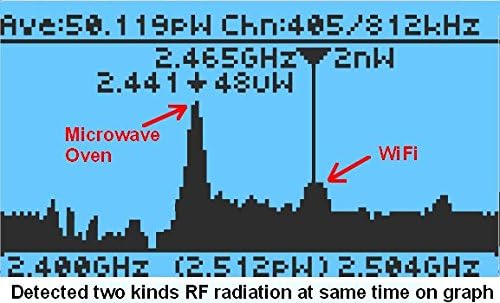
- Identify and detect common possible sources, such as power line, cell tower, microwave, static charge, etc
ASIN:
- B07JGJ897T
Category:
- Electrical Testing / Radiation Meters
| brand | GQ |
|---|---|
| color | Gray |
| weight | 10 Ounces |
| Colour | Gray |
| Power source | Corded Electric |
| Item weight | 10 Ounces |
| Maximum range | 10 Metres |
| Mounting Type | Wall Mount |
| Battery Description | Lithium-Ion |
| Temperature Range | 5 Grad Celsius |
| Compatible Devices | computers |
| Number of Batteries | 1 LR44 batteries required. |
| Operating Temperature | 5 Degrees Celsius |
| Antenna Location | Testing and monitoring electromagnetic radiation |
| Frequency | 10 GHz |
| Item Dimensions D x W x H | 2.5D x 7.6W x 14H centimetres |
| Manufacturer | GQ Electronics |
| Part Number | EMF-390 |
| Model Number | EMF-390 |
| Country of Origin | USA |
| ASIN | B07JGJ897T |
| Customer Reviews | 4.4 4.4 out of 5 stars (3,184) 4.4 out of 5 stars |
| GTIN | 723794245272 723794245364 |
- Online user manual in English and German
- Identify and detect common possible sources, such as power line, cell tower, microwave, static charge, etc
Das Gerät wird nett verpackt in einer kleinen Kartonschachtel geliefert, zusammen mit einem USB-C Ladekabel, einem Etui, einer Kurzanleitung sowie eine Infokarte mit empfohlenen Grenzwerten. Beim Auspacken fällt positiv auf, wie sauber das Gerät verarbeitet wurde. Die Langversion der Anleitung kann/muss beim Hersteller heruntergeladen werden.Erste, grobe Tests zeigen, dass das Gerät gut zu funktionieren scheint. Handy, Microwelle, Wi-Fi-Router und Netzgeräte werden richtig erkannt. Wie genau die dabei angezeigten Werte sind lässt sich natürlich nicht ohne weiteres erkennen. Eine absolut korrekte Einschätzung liesse sich mit einem korrekt kalibrierten Zweitgerät aus einem höheren Preissegment erreichen. Elektro-magnetische Wellen verlieren die Stärke im Quadrat zur Entfernung, so dass schon geringe Unterschiede im inneren Aufbau der Geräte, der Lage der Antennen sowie wie sie in der Hand gehalten werden, grosse Unterschiede in der Anzeige verursachen.Die Einheit Volt pro Meter (V/m) beschreibt die elektrische Feldstärke (E) und gibt an, wie groß die elektrische Spannung (U) pro Meter Abstand (d) zwischen zwei Metallplatten ist. Sie zeigt also, wie stark eine elektrische Kraft auf eine Ladung in diesem Feld wirkt:Die Formel zur Berechnung der elektrischen Feldstärke lautet: E = U / dSo habe ich einen entsprechenden Messaufbau erstellt um die Genauigkeit des Gerätes auf die Probe zu stellen.Bei einer Spannung (U) von ca. 240,4 V (AC, Hausnetz) und einem Abstand (d) von 0.3 Metern misst das Gerät ganz nahe (ca. 5 mm Abstand!) an der Platte die mit dem Aussenleiter (Phase) verbunden ist eine elektrische Feldstärke (E) von 802.5 V/m (siehe Bild), das ist ein sehr guter Wert! Rein rechnerisch hat das Feld ein Stärke von 801.3 V/m, damit liegt das Gerät, extrem nahe am Soll-Wert. Wenn man das Gerät Richtung der anderen Platte, die mit den Neutralleiter verbunden ist, verschiebt sinkt der angezeigte Wert bis auf ca. 150 V/m. Das ist bei jedem EMF-Meter, das ich bisher getestet habe der Fall. Warum sich zwischen den beiden Metallplatten nicht überall die selbe elektrische Feldstärke messen lässt, ist mir mit meinen bescheidenen, physikalischen Kenntnissen nicht bewusst.Der Test zeigt, dass das Messresultat für ein EF-Messgerät in dieser tiefen bis mittleren Preisklasse eine absolut solide Leistung ist.Das Foto zeigt die Messung bei angelegter Spannung (240,4 V), das Gerät ist sehr nahe an der Platte positioniert, die mit dem Aussenleiter (Phase) verbunden ist. Würde ich das Gerät noch naher an die Platte verschieben, würde der der Wert schnell 1000 V/m übersteigen.Alles in allem liefert dieses Gerät ein sehr gutes Messresultat - zumindest bei EF-Messunngen. Eine grobe Einschätzung der Feldstärke(n) kann also durchaus vorgenommen werden, und das Bewusstsein und das Wissen über dieses Thema allgemein kann erweitert werden. Grundsätzlich sollte man sich aber schon mit dem Thema befassen, bevor man anderen Leuten so ein Gerät unter die Nase hält und ihnen Angst einjagt, weil es hier oder dort rot blinkt! Wir sollten nicht vergessen, dass Elektro-Magnetismus eine Urkraft ist, ohne die unser Universum, und damit die Welt und das Leben nicht existieren könnten. Und wer sich ständig auf Flucht vor Elektro-Magnetsichen Wellen (oder dem per se negativ behafteten Wort "Strahlung") befindet und meint in der Natur draussen fände sei alles besser, dem sei hier gesagt, dass allein das sichtbare Licht (ebenso eine Elektro-magnetische Welle!) als relativ kurzwellige Strahlung an einem hellen Tag schon ca. 100 W auf den menschlichen Körper wirft und damit Mikrowelle-Ofen, Handy und Co. an Stärke und höher-energetischer Kurzwelligkeit um ein hundert- oder tausenfaches übertrifft! Und nicht zu vergessen, dass jeder Mensch selbst relativ kurzwellige elektro-magnetische Wellen in Form von Infrarot-Strahlung in für uns spürbarer Wärme abgibt.Fazit: Das Gerät ist noch relativ preisgünstig und liefert dennoch ein gutes Ergebnis.
Der EMF-390 3-in-1 Detektor hat meine Erwartungen übertroffen! Es misst zuverlässig EMF-, ELF-, RF- und HF-Strahlung und ist damit ideal zur Überwachung von Mobilfunkmasten, WLAN, Bluetooth und anderen elektromagnetischen Quellen.Besonders beeindruckend ist die Vielseitigkeit: Dank der Mehrfeld-Technologie liefert das Gerät präzise Messergebnisse in Echtzeit. Der integrierte Datenlogger ist ein großes Plus, um Messwerte zu speichern und später auszuwerten. Die Bedienung ist trotz der komplexen Funktionen intuitiv und benutzerfreundlich.Das Display ist gut ablesbar, und die kompakte Bauweise macht es perfekt für den mobilen Einsatz. Wer ein professionelles Messgerät für EMF-Strahlung sucht, ist hier genau richtig. Absolute Kaufempfehlung! ✅
Ok
Generally I am satisfied.It detects all the sources I know. But it behaves a little different, another device from other company detects rf where the 390 does not in a wall of my house. I do not see any sources nearby though. But I am not exactly sure which is more accurate. Logically the 390 as i do not see sources.
Good multipurpo
I just got my GQ EMF-390 meter and have spent a number of hours playing with it and testing it. I like it, and it's a good meter, but you gotta learn to sweet talk to it. In other words, you have to invest some time in learning how to use it properly. I am just a user. I have no official affiliation with GQ.I am in training with the Building Biology Institute to become an Electromagnetic Radiation Specialist (EMRS). I'm speaking for me, not for them though. But, I mention it because I've spent a lot of time studying EMF meters and EMF measurements lately. That point of view affects how I view these instruments. Here are some things that I believe will help you use your instrument.01) This is a consumer grade instrument, which they say in the FAQ, not professional grade. So, balance your expectations accordingly. However, that doesn't mean it can't be useful to a professional, as well as consumers.02) The quick start guide is just that. Do read it. But realize that's only the beginning of your journey. Download the full user guide, which is a PDF of many pages, and go through that. At least their documents are written in mostly good English, as opposed to Chinese-English. As a bonus, the quick start guide is in color.03) Learn how to operate the controls. This may not be obvious at first. Once you've gotten used to them, it will seem much more natural. While the buttons don't have printed labels on them, they do have shapes molded into the plastic, which you can see if you look.Some buttons do different things depending on whether you press and release, or press and hold.If you have the meter facing you, in landscape (wide) mode, and the buttons and model number are on the right:The TOP button, which they call S4, can: check the battery when powered off, power the unit on and off, activate the menu system when powered on, select items in the menu system, and sometimes change things in the menu system.The BOTTOM button, which they call S1, can: back you out of most menus, activate a menu to select the different screens of the device.So, an effective technique to go through menu settings is: press the TOP S4 button to get into the menu, press one of the middle buttons to navigate, press the TOP S4 button to select an option, press the middle buttons to change an option, press the TOP S4 button to finalize your answer. Sometimes, pressing S4 will change an answer, so make sure the screen says what you want when you're done. You can then get out of the menu system with the BOTTOM S1 button. You can, if you wish, go back into the menu, and examine each setting without changing it to verify the settings.When not in a menu, the middle S2 and S3 buttons do various things, like allowing you to alter units, switching from EMF (magnetic and electric field) mode, to RF (radio field mode), moving a cursor, zooming in or out, etc. You kind of have to play with these buttons on each screen. Sometimes they do something different if you hold them down.04) IMPORTANT, learn how to point the meter. Inexpensive meters have single axis sensors which are directional, and they care about how they're oriented in space. This meter has a 3 axis magnetic field sensor, which they label on the screen as EMF. So, you can turn the meter any way you want to read magnetic fields. BUT, the electric field sensor (EF), and the radio field sensor (RF) are directional. If you're pointing the meter the wrong way, you may get wrong readings, or no readings.I have rewritten this section of text several times, as my understanding of the antennas in the GQ EMF-390 has changed. I will share my best understanding, but the reception pattern of the meter is not totally clear. So, you may have to point and orient the meter in various different directions and rotate it in various orientations to find the way you get the maximum signal in any given situation. See the EMF-390 How Is General RF Antenna Oriented link below for additional information.Antenna placement is documented on page 5 of the quick start guide, as well as in the PDF. Nevertheless, it bit me and caused me to lose some sleep one night fretting with it. I haven't done much with the EF sensor, but I've been working with RF. This meter may not work like you expect, but it will work if you treat it right. My Safe and Sound Pro II meter and my Cornet ED88TPlus will both respond to most RF signals if you are holding the meter in front of you in portrait mode (vertically), with the display facing you, and the RF source, like a cell tower, out in front of you. This meter may not respond optimally that way. With this meter, you would be pointing one of its sensors up into the sky. As I understand it, this meter has a 2 part general RF sensor. One part would respond to a source out in front of you if holding in portrait mode in front of you. The other part would respond if pointing the curved surface of the meter toward the transmitter. The first descriptions below are based primarily on the latter mode. Then I talk more about the former mode.Imagine this meter is a small airplane. Place the meter flat on a table with the buttons and label near you and the display face up. The near end with the buttons is the tail. The far end where the propeller of a plane would be (its nose) is the front. On the GQ EMF-390, this surface is curved. The far end, curved surface, of the meter is where one part of the RF sensor is pointing. If there were a cell tower, for example, out in front of your table, you could get a reading on it. In terms of an airplane, pitch means to bring the nose up or down. Yaw means to slide the tail left or right, turning without changing the bank of the wings. And roll means to bank or tilt the wings left or right. Rolling left or right is (sort of) what a race car does going around a sharp turn on a banked track.For lack of better terms to use, this meter CARES about pitch, roll, and yaw. If you pitch the nose of the meter up or down substantially off the line to the source, you will get bad or no readings. If you yaw the meter left or right substantially off the line to the source, you will get bad or no readings. But, that's not all. The meter cares about roll too.Just to be clear, ALL single axis meters care about these things. The Safe and Sound Pro II is RF only with a single axis sensor. The Cornet ED88TPlus has EF, MF (or EMF), and RF sensors, all of which are single axis. All these meters will give bad readings if they're pointed wrong.
really good product
Exellent product
Accurate and simple to use 3 in 1 (EMF/EF/RF) meter
This meter is half the price of equivalent competitors and provides everything a budding home worker or concerned parent could possibly need. Easy to use and sensitive enough to be able to easily sense check that the meter readings are reliable (which they are with mine). Super accurate in fact, especially when held correctly (as shown in small printed instructions). I wanted it to check my home office and particularly the electric / electromagnetic field fields and radio frequencies (aka WiFi exposure) at my desk & kitchen table (for home working under lock down). With some small changes was able to reduce our exposure to all forms of invisible radiation by more than 10 times. Also was able to see change in RF in real time as I used WiFi on my iPad. I already knew that you should not hold your iPad in your hands and use WiFi but the results were an eye opener. Needless to say my desktop computer is not connected by Ethernet cable and favoured (whenever possible) over the iPad. I have also move the modem (which is really harmful at short range, shit these things should come with a serious health warning!) as far from me as possible. This device is a God send and only after I had bought this meter did I watch 'Better Call Saul'. So glad I went for this meter and would recommend to anyone remotely concerned about their health with all the debate raging over 5G
高エネルギーの充電式リチウムイオン電池が使用されています。電磁波過敏症の重症者は、充電式リチウムイオン電池から放出される低周波電磁波で病状が悪化しかねないので、お勧めしません。高周波と低周波の両方を測定できるなど性能はよいので普通の人には問題ないと思います。
It is a good buy.
Very good instrument and very fast and accurate delivery.
Lo he utilizado únicamente para medir la intensidad/densidad de las ondas electromagnéticas emitidas por una cocina de cuatro placas de inducción (para ver si podía cocinar sin riesgos después de la implantación de un marcapasos). Y el aparato ha sido muy sensible en la medición, diferenciando claramente entre lo emitido por cada una de las cuatro placas, así como mientras me alejaba/acercaba de cada una de ellas.Inconveniente menor: el manual de instrucciones no viene en español/castellano.
Knew alot about EMF and RF around my places and surrounding
What amazing was knowing how much EMF is emitted during charging of mobile phones. I was charging my mobile at bed side before I had this detector. Once I saw the Extremely high EMF from the cable and that charger, I stopped charging overnight next to my bed.Was also suprised that Hyundai Ioniq 5 EV does not producted much EMF during driving, but didn't have change to test when the vehicle was on charge.I am able to know how frequent the mobile phone tower was communicating with my mobile phone. Not to put mobile phone on trouser pockets due to high RF.
Frequently bought together
Useful add-ons and products customers often order with items like this.
+

+
Total for selected items6444250 IQD



Similar products
Compare alternatives from the same category, brand or feature set.


essence cosmetics
essence Let the party glow on! False lashes, fake lashes, false lashes, No. 01 Let's Get This P…
16000 IQD


Aditri Creation
Decorative Round Velvet Pooja Cloth Mat Aasan Cloth with Sequence Work for Indian Traditional F…
30250 IQD

Aditri Creation
Decorative Toran Door Hanging Design Beads and Tassels Wall Toran Wall Hanging for Main Entranc…
38250 IQD

Aditri Creation
Set of 2 Door Hanging Colourful Decorative 5 Fabric Moon & Star String for Festival Traditional…
38250 IQD

Aditri Creation
Decorative Toran Door Hanging Artificial Velvet Cloth Bandanwar Bead Wall Main Entrance Temple …
38250 IQD

Aditri Creation
Designer Door Hanging Colorful Decorative 3 Fabric Elepant String for Indian Traditional Festiv…
34250 IQD

Aditri Creation
Set Of 2 Designer Door Hanging Colorful Decorative 2 Horse String for Indian Traditional Festiv…
34250 IQD


Product buying guide
This product from GQ in Electrical Testing / Radiation Meters can be reviewed by features, specifications and available options before ordering.
What stands out
- Online user manual in English and German
- Identify and detect common possible sources, such as power line, cell tower, microwave, static charge, etc
Before you buy
- Confirm the dimensions: 2.5D x 7.6W x 14H centimetres.
- Estimated item weight: 10 Ounces.
- Compare it with the similar products below if you want another brand, price or feature set.